
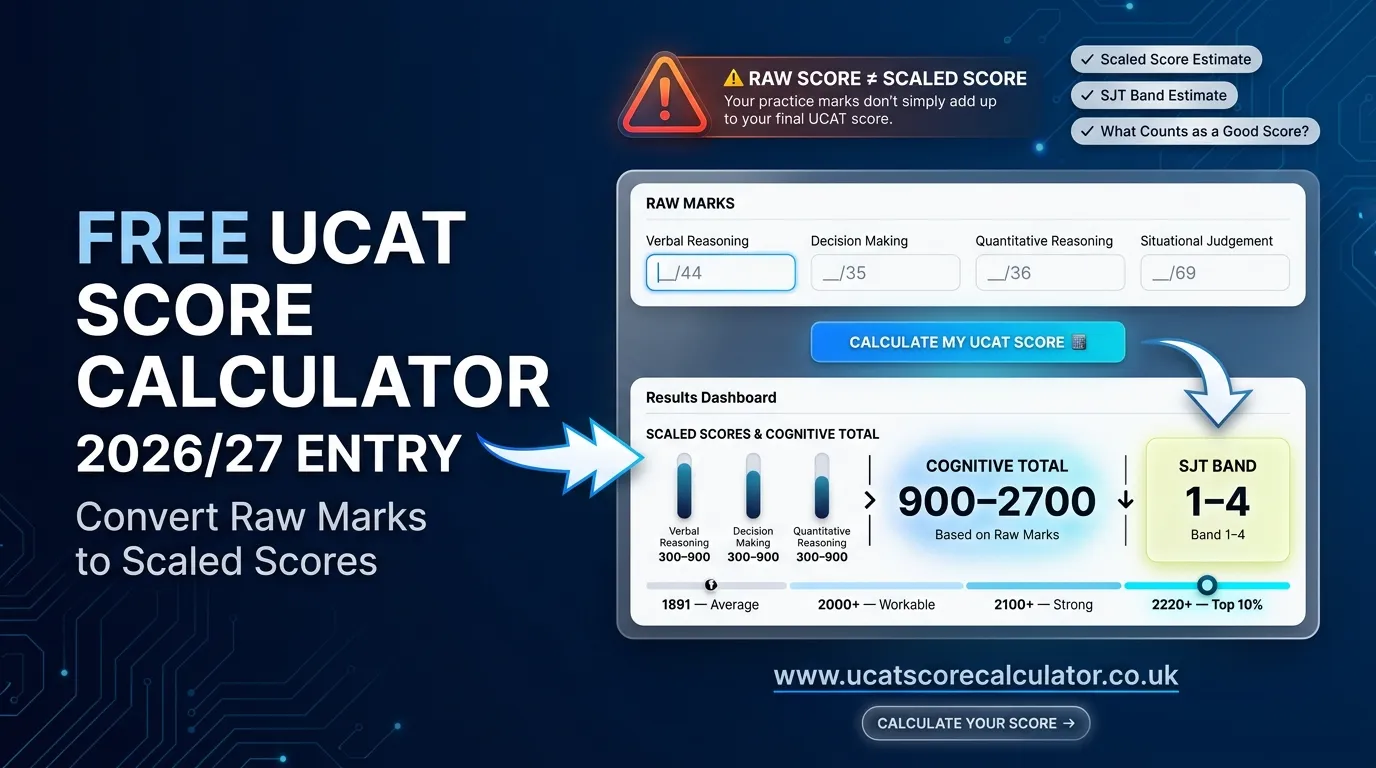
Free UCAT score calculator for 2026/2027 entry. Convert raw marks to scaled scores out of 2700, check your SJT band, and see what counts as a good UCAT score.
Raw marks
Estimated result
Good alignment with expected professional behaviours. Reported separately — not part of the 2700 total.
If you’ve just finished a practice paper and you’re staring at a raw mark wondering what it translates to on the real UCAT scale, you’re not alone. This is one of the most common points of confusion for anyone preparing for UCAT 2026 entry (or 2027 entry) — the test doesn’t simply add up correct answers. Every section is converted onto its own scaled score, and understanding that conversion is often the difference between panicking over a practice score and actually knowing where you stand.
That’s exactly what our UCAT score calculator is built to solve. Type in your raw marks for each section, and it converts them into the same 300–900 scaled score format the real UCAT uses, adds up your UCAT total score out of 2700, and estimates your SJT band.
How UCAT Scoring Actually Works
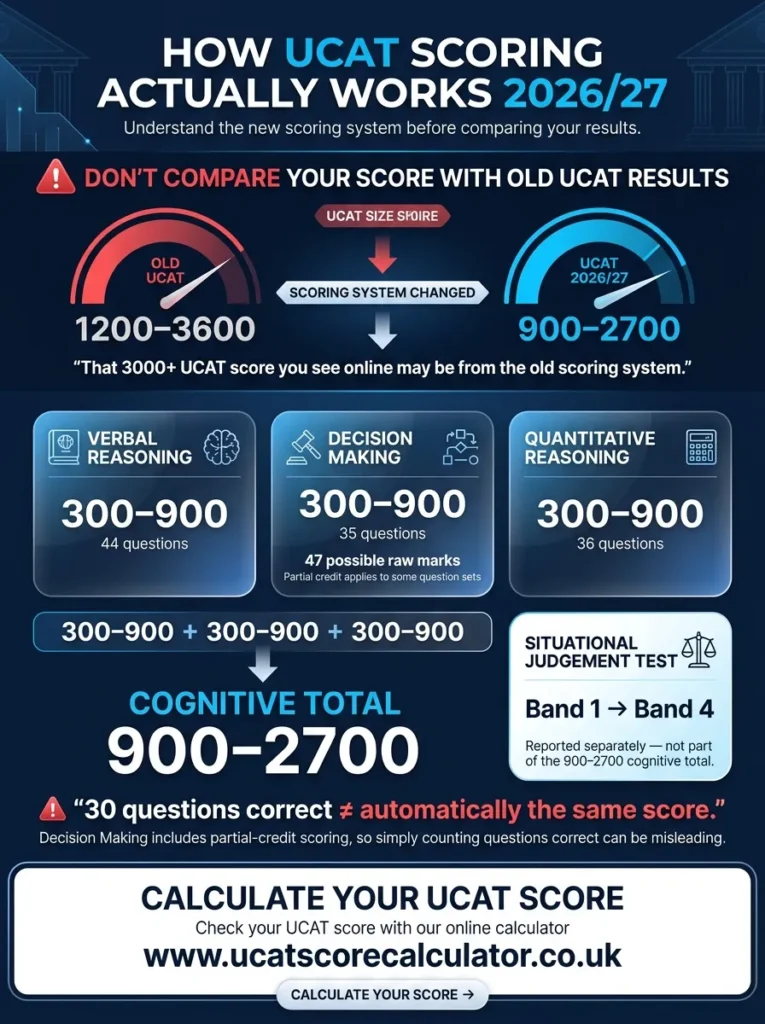
Since 2025, the UCAT no longer includes Abstract Reasoning. That’s a bigger change than it sounds — it means the total score range shifted from the old 1200–3600 scale down to 900–2700. If you’ve seen an older sibling’s or friend’s UCAT result quoted from before 2025, it’s simply not on the same scale, and comparing the raw numbers directly will mislead you more than help you.
The UCAT cognitive total is now made up of three sections: Verbal Reasoning, Decision Making, and Quantitative Reasoning. Each one is scaled independently from 300 to 900, and the three are added together for your final total. Sitting alongside that, but reported completely separately, is the Situational Judgement Test, which doesn’t get a numerical score at all — it gets a band from 1 to 4.
Here’s where a lot of calculators and guides get a little lazy, and it’s worth knowing because it changes how you should read your own practice results. Verbal Reasoning has 44 questions, and it’s genuinely the harshest of the three sections when it comes to scaling — candidates typically need close to 40 out of 44 correct just to reach the very top of the scale. Quantitative Reasoning, by contrast, is more forgiving at the top end, with the ceiling reachable from around 33 out of 36. And Decision Making is its own puzzle entirely, because it isn’t simply out of 35 — it actually carries 47 raw marks in total, since twelve of its question sets use partial credit. Get all five parts of one of those sets right and you earn 2 marks; get four right and you still get 1 mark. That’s why two people who both say they “got 30 questions right” in Decision Making can walk away with noticeably different scaled scores.
What Counts as a Good UCAT Score in 2026
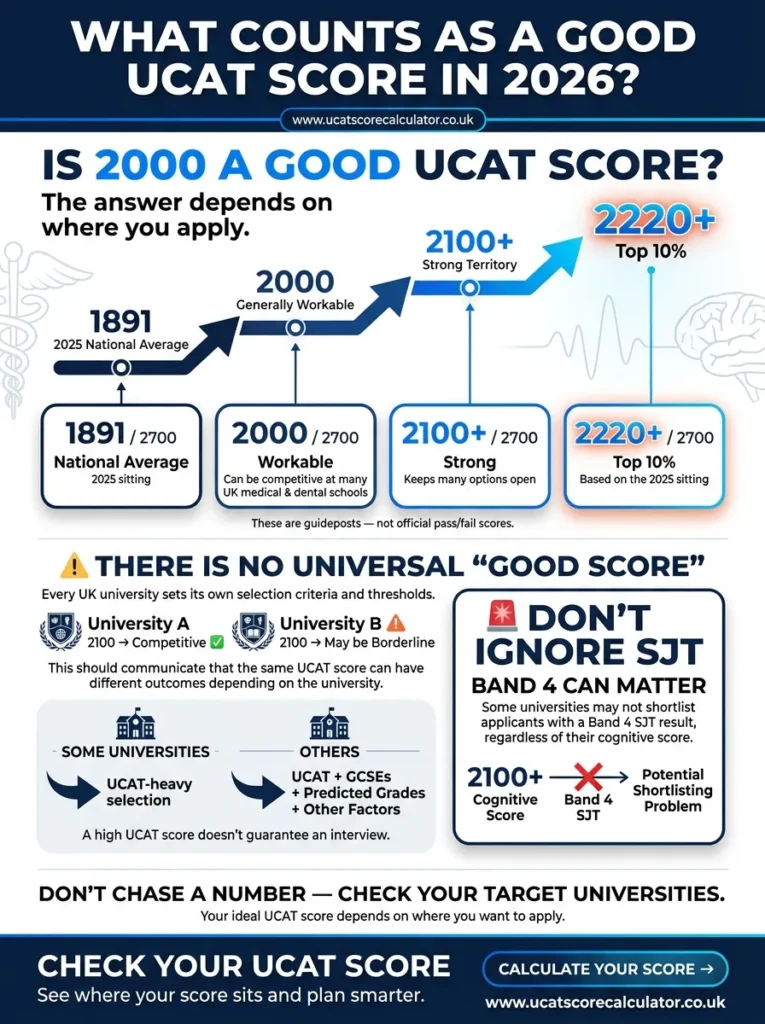
This is the question everyone actually wants answered, so let’s be direct about it rather than vague. The national average for the 2025 sitting came in at 1891 out of 2700. A score around 2000 is generally considered workable at a good number of UK medical and dental schools. Push past 2100 and you’re in strong territory that keeps most doors open. And if you’re up around 2220 or higher, you’re sitting in the top 10% of everyone who sat the test that year.
None of these numbers are a hard pass or fail line, though — and this matters more than most calculators let on. Every UK university sets its own threshold, and that threshold moves depending on the year’s applicant pool. Some schools, like Bristol historically, lean almost entirely on the UCAT total to decide who gets an interview. Others treat it as just one part of a wider picture that includes GCSEs, predicted grades, and your personal statement. So a 2100 that opens doors at one university might sit right on the edge somewhere else.
There’s also a detail that’s easy to overlook if you’re only watching your cognitive total: some universities will not shortlist you if you score a Band 4 on the Situational Judgement Test, no matter how strong your numerical score is. So if your practice SJT results keep landing you in Band 4 territory, that’s worth just as much attention as chasing a higher Verbal Reasoning mark.
How to Get the Most Out of This Calculator
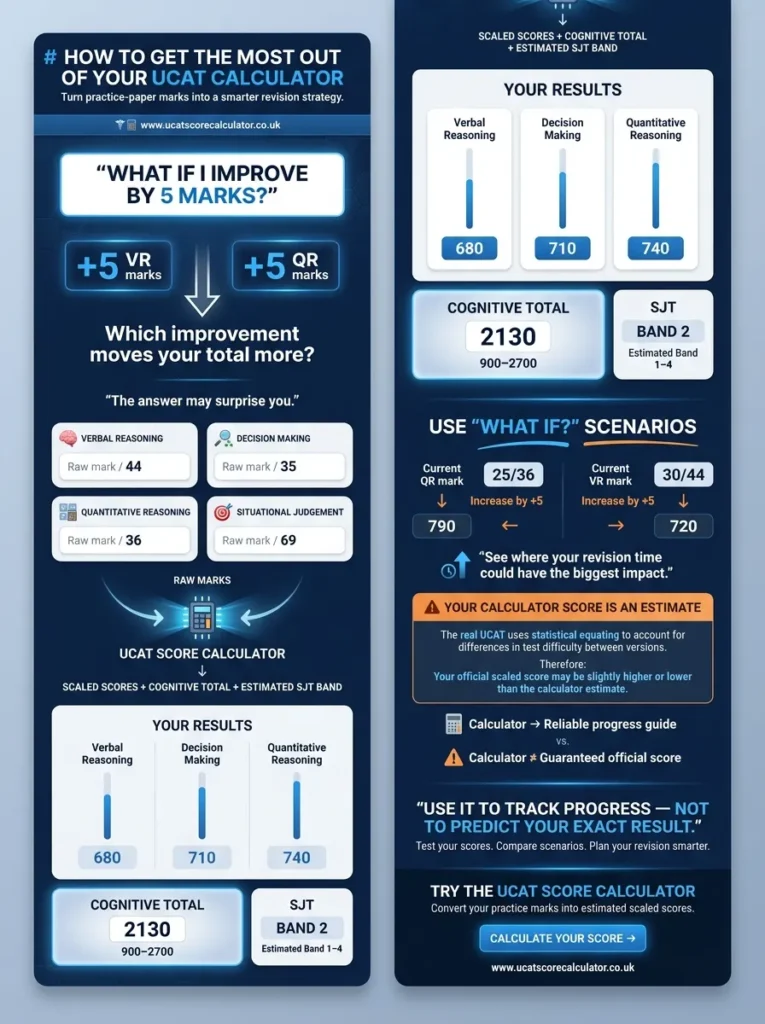
Enter your raw mark for each section as you’d write it down from a practice paper — your Verbal Reasoning mark out of 44, Decision Making out of 35, Quantitative Reasoning out of 36, and your Situational Judgement mark out of 69. The calculator converts each into its scaled equivalent, totals your three cognitive sections, and gives you an estimated SJT band. It’s genuinely useful for testing “what if” scenarios too — if you’re deciding where to focus your remaining revision time, try nudging your Quantitative Reasoning mark up and see how much more it moves your total compared to the same improvement in Verbal Reasoning. Because the sections scale differently, the answer isn’t always what you’d expect.
One honest caveat worth repeating: the real UCAT uses statistical equating to adjust for slight differences in difficulty between test versions, so your official scaled score can land a touch above or below what a simple proportional estimate like this one predicts. Treat it as a very reliable guide for tracking your progress, not as a guarantee of your exact final number.
Frequently Asked Questions
What is a good UCAT score for 2026/2027 entry?
Anywhere from around 2000 upward is generally considered workable at UK medical and dental schools, 2100+ is a strong result, and 2220+ places you in the top 10% of candidates nationally — though the exact bar shifts by university and by year.
Does the SJT band count towards my UCAT total?
No. It’s reported on its own separate scale from Band 1 to Band 4 and never gets added into your 900–2700 total, but it’s still checked independently by many universities, and a Band 4 can rule you out at some schools regardless of your total score.
Why was Abstract Reasoning removed from the UCAT?
It was dropped from the test starting with the 2025 cycle, which is also why the total score range changed from the old 1200–3600 scale to the current 900–2700 scale.
Can I compare my score to an older sibling’s or friend’s pre-2025 UCAT result?
Not directly by raw number, since that older result includes Abstract Reasoning on a different scale entirely. If you want a meaningful comparison, look at percentile or decile ranking instead of the total score itself.
Why does Decision Making feel harder to convert than the other sections?
Because it isn’t scored out of 35 the way it looks on paper — it’s actually marked out of 47 once you account for partial credit on its yes/no question sets, which is exactly the detail our calculator handles for you.
For the full official test specification, timing, and registration details, it’s worth checking the official UCAT website directly.